
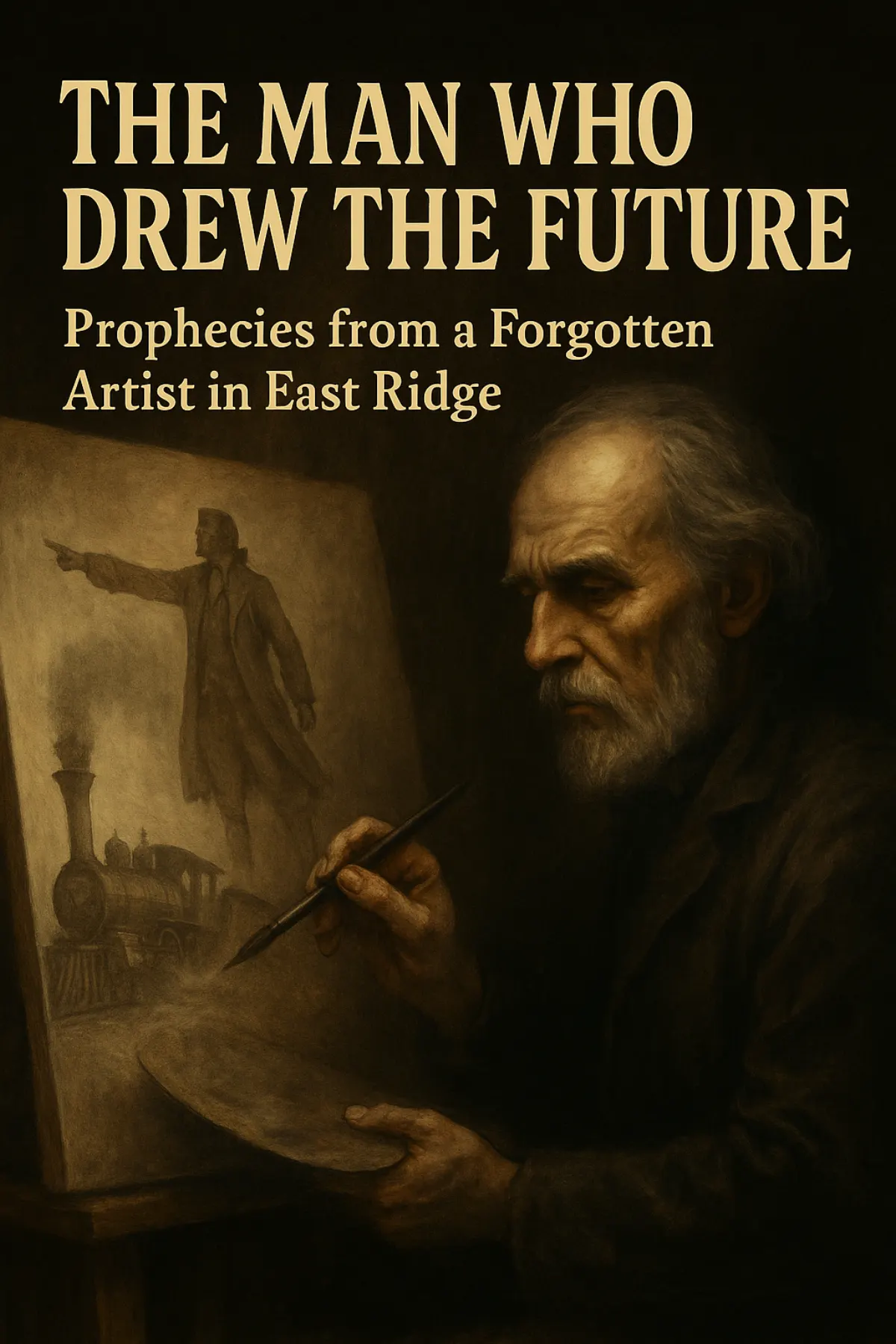
The Man Who Drew the Future: Prophecies from a Forgotten Artist in East Ridge
Introduction: The Sketchbook That Shouldn’t Exist
In 1922, a quiet artist named Samuel Forrester lived on the outskirts of East Ridge, Tennessee. He was known as a recluse—a soft-spoken man who made his living painting storefront signs and sketching portraits for the townsfolk. But when his sketchbook was discovered decades later, buried in the crawlspace of a dilapidated home, it contained drawings that stunned historians.
The sketches didn’t just depict the world of the 1920s—they predicted what was to come.
Airplanes resembling modern jets, highways cutting through the mountains, strange handheld “talking boxes,” even a city skyline uncannily similar to modern-day Chattanooga—all drawn with eerie precision decades before they became reality. Locals now call him “The Man Who Drew the Future.”
The Discovery
The story began in 1996, when a construction crew renovating an old East Ridge property unearthed a tin box sealed with wax. Inside was a weathered leather sketchbook, its pages brittle but legible.
The owner’s signature read: “S. Forrester, East Ridge, 1922.”
Within its pages were 47 sketches—each one marked with dates, symbols, and handwritten notes that hinted at something far stranger than mere imagination.
“The Great Road Through the Valley” – A drawing showing a massive concrete bridge and winding roadway, strikingly similar to modern I-24.
“The Day the Sky Fell Silent” – An image of grounded planes, dated 1942, interpreted as a reference to World War II aviation.
“The Silver River of Light” – Depicting a bridge of glowing cables spanning the Tennessee River—long before the Walnut Street Bridge lighting installation existed.
“Faces Without Eyes” – A haunting sketch of people staring at handheld rectangles that emit light—a perfect visual match for smartphones.
Forrester, it seemed, had drawn the future of Chattanooga—and beyond.
Theories Behind the Prophetic Sketches
1. A Visionary Ahead of His Time
Some historians argue that Forrester simply had an extraordinary imagination. The early 20th century was full of dreamers predicting the future—Jules Verne, H.G. Wells, and inventors like Tesla and Edison. Perhaps Forrester was simply part of that visionary wave, his artistic instincts blending with intuition about progress.
2. The Paranormal Explanation
Others believe the artist was touched by something beyond human understanding. His journal entries (found separately in the attic of the same home) contained cryptic phrases:
“I see through the mist of years… not dreams, but what will come.”
“The sketches hum when the storm rolls through. The air carries pictures of tomorrow.”
Paranormal researchers suggest Forrester may have experienced precognitive visions—a phenomenon where glimpses of the future appear through dreams, meditation, or emotional trauma.
3. The Time-Slip Theory
A more speculative idea is that Forrester was caught in a “time echo,” a psychic resonance that allowed him to perceive images from the future Chattanooga. Similar phenomena have been reported worldwide—artists, writers, or mystics describing modern inventions decades before their creation.
4. The Skeptic’s View
Of course, skeptics insist the sketchbook may not be genuine. They argue it could be a hoax planted later in the century, or that the interpretations are coincidental—a classic case of retrofitting meaning onto ambiguous art.
Yet handwriting experts confirmed the paper and ink dated back to the early 1920s, lending unsettling credibility to the mystery.
The Hidden Messages
A deeper analysis of the drawings revealed something even stranger—hidden patterns and codes:
Numerical Sequences: Some sketches contain sets of numbers that correspond to future years (1945, 1979, 2001), all linked to major historical events.
Recurrent Symbols: The serpent, the clock, and the rising sun appear throughout his work—possibly metaphors for time, rebirth, or cycles of destruction.
The Final Drawing: His last entry, dated March 1923, shows a man with a blank face standing before a mountain tunnel. Beneath it, Forrester wrote: “When the ridge hums, the past and the future meet.”
After that, there were no more drawings—and no record of Forrester ever leaving East Ridge.
Eyewitness Accounts: The Ridge That Still Hums
Locals who hike near the old quarry on the ridge sometimes report hearing strange low vibrations, like the faint hum of machinery beneath the ground. Paranormal investigators have recorded electromagnetic spikes and audio frequencies that mimic distant engines—though no tunnels or power lines exist in the area.
Some believe this “hum” marks the spot where Forrester received his visions—or where he vanished.
Top 5 Tennessee Time-Mysteries & Paranormal Predictions
The Man Who Drew the Future, East Ridge – Prophetic sketches spanning a century.
The Clockmaker’s Curse of Chattanooga – A craftsman who froze time in his workshop.
The Vanishing Train of Tunnel Hill – A locomotive that disappears once a decade.
The Blood Moon Pact of Red Clay – The Cherokee council’s enduring curse.
The Silent Choir of St. Elmo – Hymns of a congregation lost to fire.
Could He Still Be Right About What Comes Next?
Among Forrester’s final sketches are two that seem not yet fulfilled:
“The River Burns Twice” – A vision of fire reflecting off the Tennessee River. Some speculate it could symbolize industrial disaster—or a metaphorical cleansing.
“The Black Bridge That Walks” – A cryptic image showing a bridge that moves like a living creature. Modern interpreters link it to robotics, AI, or even future engineering marvels.
If his past drawings proved accurate, what do these mean for the years ahead?
Conclusion: The Artist Who Outsmarted Time
The story of Samuel Forrester—the man who drew the future—remains one of Chattanooga Valley’s most haunting mysteries. Was he a prophet, a genius misunderstood by his time, or simply a man whose imagination reached farther than reason allows?
One thing is certain: a century later, his work continues to blur the boundary between history and prophecy. And somewhere in the hills of East Ridge, perhaps time itself still waits for his next sketch.
Have you heard whispers of Forrester’s sketchbook or seen any of his lost drawings? Share your theories in the comments, explore more local mysteries, and follow us for future tales from East Tennessee’s haunted and visionary past.